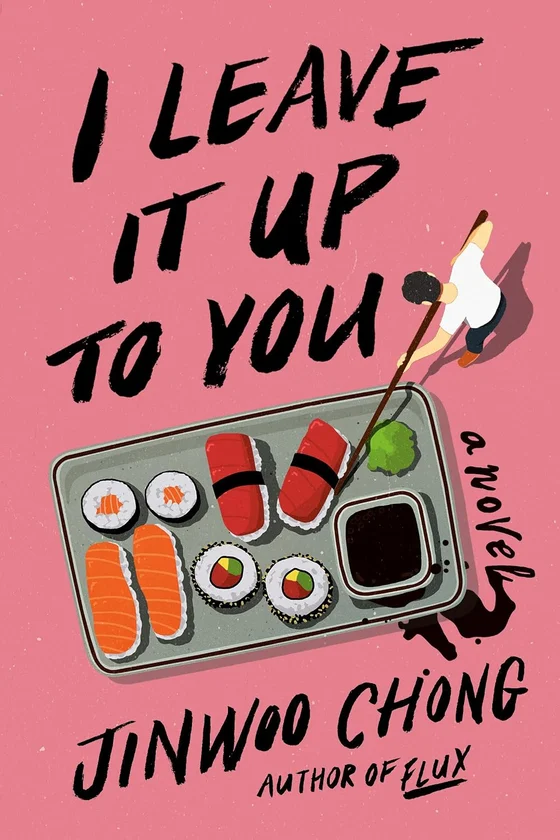
I Leave It Up to You
This book is both beautiful and gut wrenching. Uncomfortable in all the right ways, it will make you consider whether — if you were forced to forget your life and start over — would you follow the same path you did before.
It’s a powerful and at times funny story about the strength of family, both the family we’re born into and the one we choose.
“Oh, no.” She looked out over the bright day in front of us. “I am still afraid. It’s a different kind of fear. I think: Have I done all I can? Is there more I could have given? Family is give and take: When you’re born, you take, and when you get older, you give, more and more, to everybody that gave to you. To them.”
Publisher's Description
From the award-winning author of Flux comes “an endearing novel about second chances” (The Washington Post), with wise insights into love, family, and the art of sushi.
“Wise and poignant [with] mouthwatering descriptions of food . . . I Leave It Up to You is about finding—or rediscovering—the people who make hardship worth enduring.”—Bobby Finger, The New York Times Book Review (Editors’ Choice)
A coma can change a man, but the world Jack Jr. awakens to is one he barely recognizes. His advertising job is history, his Manhattan apartment is gone, and the love of his life has left him behind. He’s been asleep for two years; with no one to turn to, he realizes it’s been ten years since he last saw his family.
Lost and disoriented, he makes a reluctant homecoming back to the bustling Korean American enclave of Fort Lee, New Jersey; back into the waiting arms of his parents, who are operating under the illusion that he never left; and back to Joja, their ever-struggling sushi restaurant that he was set to inherit before he ran away from it all. As he steps back into the life he abandoned—learning his Appa’s life lessons over crates of tuna on bleary-eyed 4 a.m. fish runs, doling out amberjack behind the omakase counter while his Umma tallies the night’s pitiful number of customers, and sparring with his recovering alcoholic brother, James—he embraces new roles, too: that of romantic interest to the nurse who took care of him, and that of sage (but underqualified) uncle to his gangly teenage nephew.
There is value in the joyous rhythms of this once-abandoned life. But second chances are an even messier business than running a restaurant, and the lure of a self-determined path might, once again, prove too hard to resist.