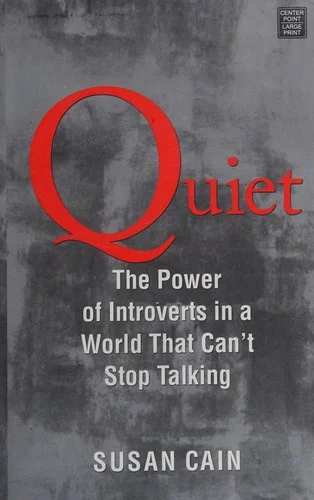
Quiet
The Power of Introverts in a World That Can't Stop Speaking
This is an incredible book I’ve returned to many times. I was raised in a fish bowl and continued that life for a long time, then traded it for a courtroom stage with high-profile trials, political maneuvering, and strong external expectations that extroversion is a virtue to strive for. During that time, returning to this book would re-ground me in the strengths of my natural introversion, even as the career paths I chose never aligned with it.
In this more recent season of my life, I hope to better align my work with this introverted part of myself and reduce the need to perform, the desire to seek external approval, and the expectation that extroversion is a goal.
“Introverts, in contrast, may have strong social skills and enjoy parties and business meetings, but after a while wish they were home in their pajamas. They prefer to devote their social energies to close friends, colleagues, and family. They listen more than they talk, think before they speak, and often feel as if they express themselves better in writing than in conversation. They tend to dislike conflict. Many have a horror of small talk, but enjoy deep discussions.”
“So stay true to your own nature. If you like to do things in a slow and steady way, don't let others make you feel as if you have to race. If you enjoy depth, don't force yourself to seek breadth. If you prefer single-tasking to multi-tasking, stick to your guns. Being relatively unmoved by rewards gives you the incalculable power to go your own way.”
Publisher's Description
Passionately argued, impressively researched, and filled with indelible stories of real people, Quiet shows how dramatically we undervalue introverts, and how much we lose in doing so. Taking the reader on a journey from Dale Carnegie's birthplace to Harvard Business School, from a Tony Robbins seminar to an evangelical megachurch, Susan Cain charts the rise of the Extrovert Ideal in the twentieth century and explores its far-reaching effects. She talks to Asian-American students who feel alienated from the brash, backslapping atmosphere of American schools. She questions the dominant values of American business culture, where forced collaboration can stand in the way of innovation, and where the leadership potential of introverts is often overlooked. And she draws on cutting-edge research in psychology and neuroscience to reveal the surprising differences between extroverts and introverts. Perhaps most inspiring, she introduces us to successful introverts–from a witty, high-octane public speaker who recharges in solitude after his talks, to a record-breaking salesman who quietly taps into the power of questions. Finally, she offers invaluable advice on everything from how to better negotiate differences in introvert-extrovert relationships to how to empower an introverted child to when it makes sense to be a "pretend extrovert." This extraordinary book has the power to permanently change how we see introverts and, equally important, how introverts see themselves. - Publisher.